Since moving to a co-housing community “bofællesskab” just outside Copenhagen earlier this year I’ve found myself (trying to) explain it friends/ family/ colleagues.
It’s a really interesting “form of living” that particularly works for young families (like us), and yet most people (myself included before moving) haven’t heard about it, nor realised that such a set up is possible. I therefore want to make more people aware of it.
A spectrum of shared living
I used to think that when it came to where you live, it was either “live in some sort of hippie collective” or “buy/ rent a house like a normal person”.
For the latter, there could always be neighbourhoods where spontaneous playdates/ gatherings/ ‘come round for dinners’ happen, but essentially: your house is your house and you otherwise say hi to neighbours to varying degrees.
In 2020 I stumbled across a podcast called IMAGINE – Exploring the brave new world of shared living and it opened my eyes ears to the fact that things didn’t need to be binary.
Over four episodes, the show explores the whys/ whats/ and hows of different types of shared living, but one form that stood that to me and my wife was the concept of a “bofællesskab” (in Danish, literally ‘living community’).
When our first child was on the way, we weren’t ready to leave Copenhagen and so moved to an apartment on the outskirts of the city, but when #2 was in play, we felt it was time to “move out”.
The concept of co-housing communities, is somewhat commonplace in Denmark, and so we kept an eye on new houses for sale via this website and spent some weekends over several months checking out various ones before finding one we liked and could (just) afford, and then moving in earlier this year.
In short: I think it’s great.
The core premise
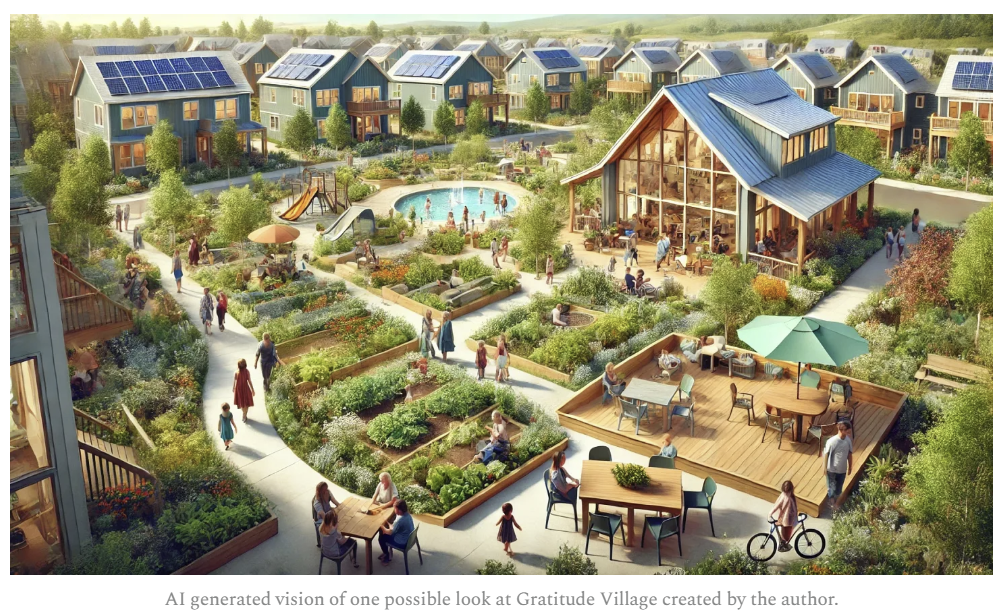
The central idea of a co-housing communities seems to be that they are a collection of x houses where, as well as the house you live in, residents also own 1/x of the communal areas.
This means that as well as your house, you also (collectively) own numerous ‘assets’/ traditions, and as such as are motivated to (collectively) look after them with your neighbours.
This then comes with benefits of all the things that become possible when you live in proximity to people who are motivated to get along with each other, and are all “in it for a bit of community”.
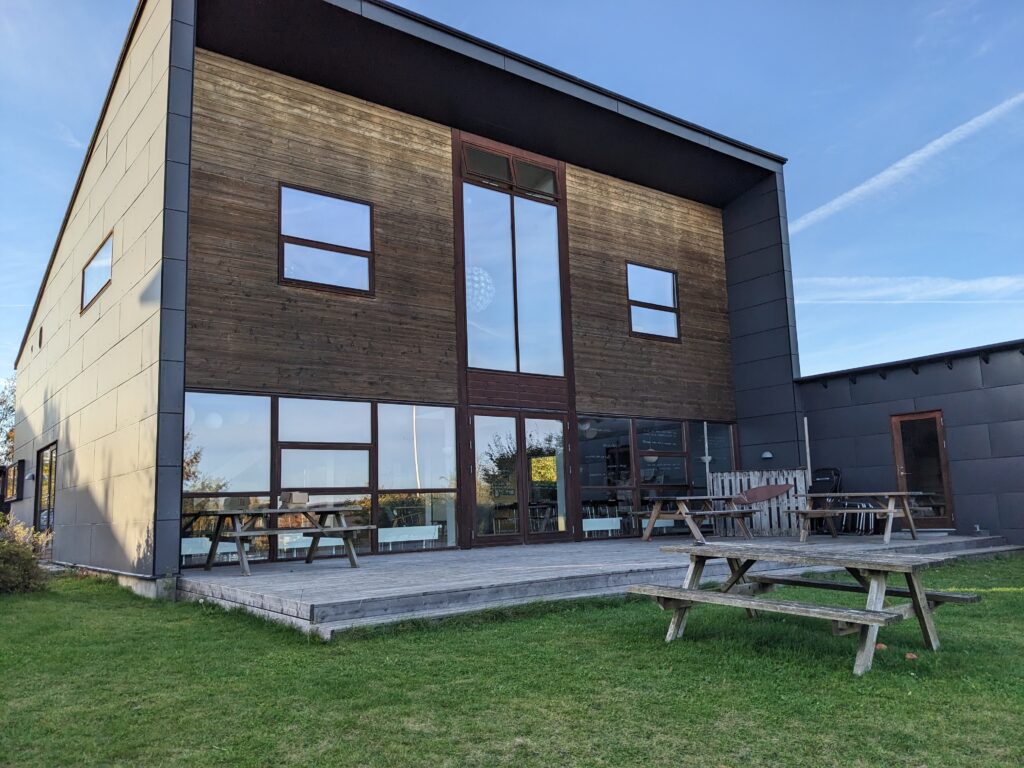
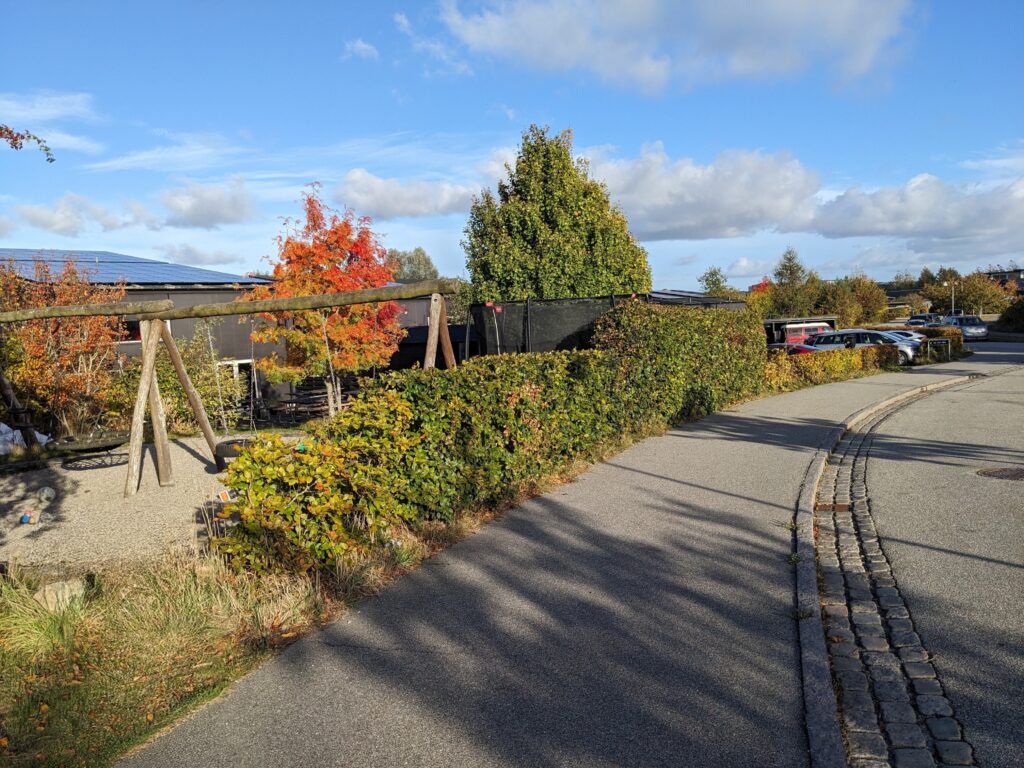
The communal areas consist of both “the bits in between” the houses, but also fixed structures, such as a playground, a shed for shared garden tools, and importantly a “communal house”.
The communal house serves several functions:
- Obvious place to hold communal activities throughout the year
- A place for useful communal <assets> such as a soft play room + big screen TV
- A big place for residents to (privately) use e.g. for large gatherings
It’s also the place where communal dinners are cooked and eaten three times/ week.
Communal dinner 3x/ week
The thing that is most tangibly different in our every day life from living in our co-housing community is that we get dinner (and washing up ♥️) done for us 11 times/ month.
The set up is broadly as follows:
- Most of the adults (+ some of the teenagers) are signed up to be in one of 4 “food teams” of ~12 people
- Each food team is responsible for cooking dinner each week for the ~60 people who come along (ours has dinner 3 days/ week)
- People in the food team sign up to be either a “head chef” (comes up with what meal to cook) or a “sous-chef” (who helps out with the cooking)
- There are then other jobs assigned to that team such as ordering the food, unpacking it, washing up after cooking
- The head chefs write down the meals on a piece of paper in the communal house a couple of weeks in advance, and residents sign up for how many meals they’d like
- All the cooking/ washing up happens in the ‘industrial kitchen’ in the communal house
- All the eating happens in the main area, or back home (there’s no shame in “having takeaway”)
The food quality is surprisingly good (there are some semi-competitive head chefs in the community) and at the end of the year, someone tallies up how many meals you had divided by the total grocery spend. On average it’s ~£4.50/ meal.
Many co-housing communities point to communal dinners as both the glue to bring people together throughout the year. One of our residents called it “the ultimate parenting hack”.
Our youngest finds being in a room full of people (near bedtime) to be a bit overstimulating and so are averaging eating in the communal house once a week and doing takeaway twice.
Our eldest (3.5 years) isn’t so happy about this as she’d rather be down there playing with her friends, and so occasionally one of us will go, or she’ll sit with another family and head back home by herself.
Unsupervised play
My podcast/ social media bubble is often frequented by Jonathan Haidt.
He’s written several books on the topic of how the way kids are raised today is generally quite detrimental to their wellbeing (see The Anxious Generation) and his antidote is (in theory) fairly simply: allow kids to learn to be independent, especially by playing/ doing stuff without adults.
Whilst I am conceptually bought in on this idea, the practicalities seemed a bit tricky were we to have continued living in Copenhagen.
We were in an apartment block meaning an adult almost always needed to be present to “let you in” to the building from outside. We were on the 4th floor which meant extra faff going up/ down stairs, and generally we were fairly close to main road and so would never feel fully at ease with kids wandering around solo until they were at school age.
An unintended benefit to the co-housing community is how quickly unsupervised play has kicked in.
The key reasons why seem to be:
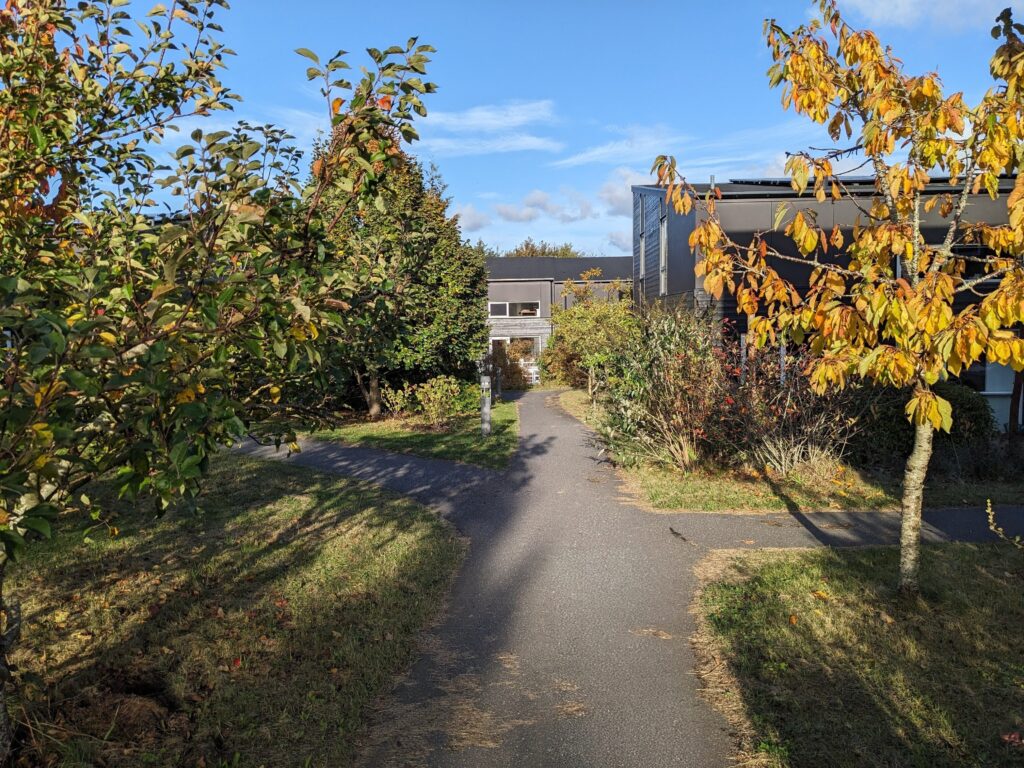
- No cars between the houses: therefore low risk for sporadic/ wobbly runners
- A clear boundary: the area is such that a 3 year old knows what is/ isn’t “our area” and can understand to ‘not cross the road without an adult’
- Activities!: communal sandpit/ trampoline/ soft play/ blackberry bushes, as well as friends’ houses within 30 seconds
- Vested adults nearby: whilst we might not be supervising our own kids, we know the others, and there’s an implicit understanding that you intervene if a kid looks to be doing something they shouldn’t.
As such, our 3.5 year old is getting lots of opportunities to freely be out “doing stuff”: going on little adventures with kids her age, interacting with kids older/ younger than she us, eating a shitload of blackberries, and (from the sounds of it) generally enjoying herself.
And a big plus for us as parents is that she doesn’t need us to be particularly involved.
She would have had the capacity to do all of the activities she currently does, but it would have involved always happening “through us” e.g. coordinating a time to go and play with someone else, walking with her down to the playground, transporting her to/ from friends’ houses, keeping an eye on her if in a public park.
With the set up as it is, we’re finding that both she’s happy, but also we as parents get more time/ energy back, even with the semi-frequent rings on the doorbell asking if she’s free to come and play.
Close, but not too close
The big fear we had when deciding whether to move to one of these communities was whether we would miss having privacy.
There are clearly benefits to having dinner cooked for you, and living in close proximity to a trampoline, but (in our case) it wouldn’t be worth the cost of constantly feeling “looked at” or feeling pressured into onerously being “part of the collective”.
Each co-housing community is different, but we seem to have landed on one that has fairly minimal ‘expectations’. Each (adult) member of the community agrees to ~2 hours/ month of “communal duties” (such as cleaning the communal kitchen, mowing the grass, doing the accounts, arranging the summer party) and above that, it’s as much/ as little as you want.
What I’ve found interesting is forming ‘relationships’ with the others. Everyone generally:
- Has similar values i.e. is the sort of person doing this still quite uncommon thing of living in a co-housing community
- Is interested in chatting to/ getting to know their neighbours
- Has been a parent at some point
As such, I’ve not found it awkward knowing whether I’m being “too much” by stopping and having a chat with a neighbour.
Having the communal house/ areas/ ‘duties’ is a non-awkward way to get to know people beyond pleasanteries, but where inviting them over would be “a bit much”.
Everyone in our community “gets” what it’s like to be a parent with small kids and so are willing to share both knowing glances and hand-me-down clothes. Our kids know/ trust various adults who, to varying degrees, are interested in how they’re getting on.
There are some who we naturally spend more time with due to life stage/ shared interests, however it’s also “distant enough” to not feel pressured into seeing people all of the time.
What’s the deal?
By this point in my conversation with curious/ sceptical friend/ colleague/ family member they begin making some sort of mental calculus of what the pay off is.
In our case, it’s as follows:
- I reckon we paid a 0-10% premium on our house compared to “non-bofaellesskab” in the area
- We pay £150/ month to the collective budget which pays for the upkeep/ development of communal assets/ traditions
- ~2 hours/ month communal duties
- ~3-4 hours cooking/ washing up per month
- 1-2 evenings/ month for “meetings” (e.g. monthly meeting for any communal updates/ decisions to make + any project work we’re part of)
- ~2 “work days” during the year to fix things up etc.
The two thoughts that come from this:
- Obviously don’t love paying more things, but for us, it seems like good value for money
- The time spent isn’t all a “cost” – it’s often nice to have low-level socialising with people who you share values with and are gradually getting to know.
We’ve had a couple of occasions where we’ve skipped another social event because we “had to” do something community-related – but on the whole it’s felt it OK.
Would it work in {the UK}?
If people are still following along, then the discussion typically goes to whether or not such a set up could work in the UK/ USA etc.
Having spent a lot of time investigating how Denmark operates, I find that there’s a spectrum of how easy Scandivanian concepts/ practices can be “transported” elsewhere.
Things like affordable childcare and work-life balance are premised upon quite a lot deep-rooted cultural norms which means that whilst not impossible, it’s quite complicated for other countries to recreate.
Co-housing communities, however, seems much more manageable.
Whilst there are a few things that make it ‘easy’ in Denmark (e.g. general high trust amongst strangers, existing legal frameworks), the fundamentals of starting one seem doable.
At its core, *all* you need is:
- A decent area of (greenfield) land: enough space for 20-60 houses/ apartments + a communal house. The ones doing well in Denmark are commutable to a city where people can earn a high wage. It could also be possible to “retrofit” co-housing community e.g. on an abandoned farm/ industrial area, though likely easier to design from a blank
piece of paperfield - The legal set up: an organisation/ association that owns the communal areas; residents (who buy/ sell the houses over time) become members of the association
- A group to kickstart it: a family/ families with the vision/ willpower to bring the project to life: coordinating the initial build, recruiting other residents, setting up the communal assets/ traditions
We “had it easy” in that we could move into an existing community.
I’ve spoken to several residents who were part of the founding members of ours who have explained how they went about it ~15 years ago.
The local government was looking to attract (tax-paying) citizens to the area and developed a strategy to encourage young families who could still commute to work in the city. They lined up housing developers and hosted a number of public meetings explaining their vision for co-housing communities in the area, eventually offering off plots of land to groups that wanted to build one.
There was then a 2-3 year process where the initial groups came together, got bank funding, worked with developers and saw the vision come to life.
At our place, a few had lived in another co-housing community and so could bring along some knowledge but, so they say, it was basically a process of ensuring the buildings got built, the initial houses got sold (to people bought in on the vision), and then building “the spirit” of the community.
Over time, the assets/ traditions have evolved, but it now operates fairly seamlessly as a self-governing and pretty “light touch” collective-ownership model.
Where to start?
No-one has actually asked me how they could start their own (maybe when we’re chatting, they’re just being polite) but if anyone were to ask, I’d say:
And if not:
- Form a nucleus: Find 5-10 households who want the same area and the same light-touch commitment. They don’t need to be your best friends (it probably helps if they aren’t).
- Write down values/ what you want: What are your expectations of each other? What do you hope to get from communal assets/ traditions? What’s off limits?
- Prioritise the communal house + car-free areas: if you go the greenfield route, design things around the communal house rather than having it as an afterthought
- Prototype the governance: pick a simple legal structure for shared stuff; set a small monthly fee; define two or three teams (food, maintenance, events) to decide how the money gets spent
- Visit one: Go to a communal dinner at an existing co-housing community to get feel for what it’s like
On an adoption lifecycle curve, I’d say we came to co-housing communities as Early Adopters.
Starting one from scratch (especially in a country that’s not Denmark) would require you to be an Innovator – but if that’s you, I highly encourage you to give it a try!
As I mentioned at the beginning of this post, it took me until the age of 30 to first hear about the spectrum of shared living, let alone find a spot on it that I quite like. Living in a co-housing community has, in many ways, been ‘life-changing’ and so I’d like for others to at least be aware of it.
If this is your first time hearing about it – or comes as part of your research, then hope you found this post useful.
If you are curious about this type of living set up, or would potentially like to visit ours/ do a “life swap” for a few months (see Semi-nomadic parenting), then feel free to let me know